
One of the most powerful aspects of youth development is watching young people identify challenges adults have learned to overlook.
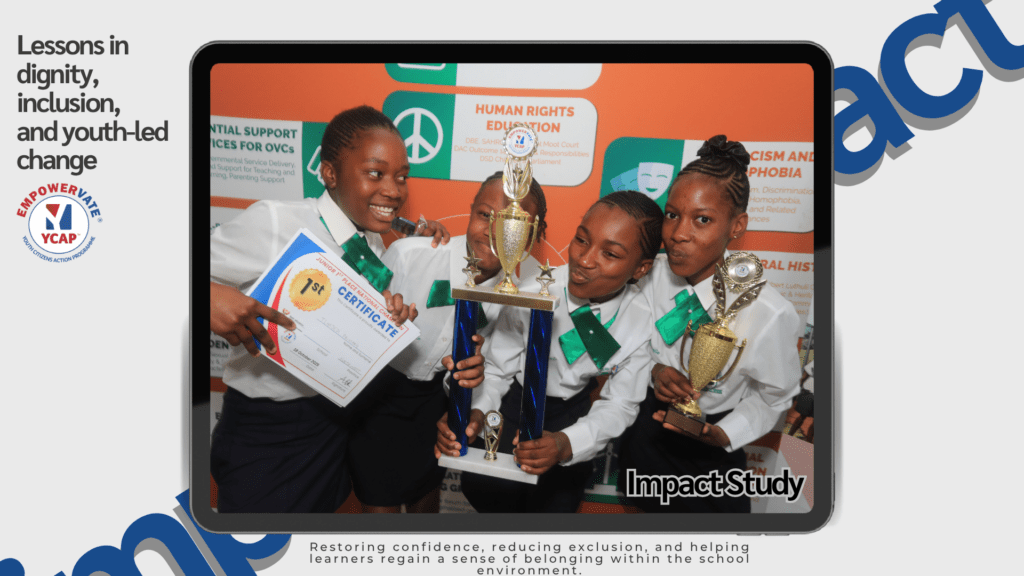
At the 16th Annual National Youth Citizens Action Programme (YCAP) Championships during October 2025, the Junior Champions from Tlhasedi Primary School in North West reminded us that some of the deepest barriers to education are not always academic. Sometimes, they are social, emotional, and deeply connected to dignity and belonging.
Their project focused on a challenge many schools quietly face every day: learners attending school without proper uniforms due to financial hardship.
At face value, school uniforms may seem like a relatively simple issue. But what made this project exceptional was the learners’ ability to recognise the wider impact uniform inequality has on a learner’s experience within the school environment. The team identified links between a lack of school uniform, bullying, segregation, low self-esteem, absenteeism, and declining academic performance.
That level of systems thinking is remarkable, particularly from primary school learners. Rather than seeing uniforms purely as clothing, the learners reframed them as a symbol of inclusion, confidence, participation, and educational belonging.
And importantly, they moved beyond awareness into action. The project mobilised teachers, parents, local businesses, school leadership, and community stakeholders to support a learner-led uniform donation initiative. Fundraising activities, donation drives, awareness campaigns, and stakeholder engagement formed part of a structured implementation process developed and managed by the learners themselves.
What stands out most from an impact perspective is the level of organisational maturity the learners demonstrated throughout the project.
The team developed: leadership structures, conflict management systems, budgeting plans, fundraising strategies, implementation timelines, sustainability plans, and communication structures.
This is an important reminder that YCAP is not simply about projects. It is about developing practical leadership, responsibility, teamwork, communication, and problem-solving skills through real-world application. The learners also demonstrated strong empathy and emotional intelligence in how they approached the issue. The project did not frame beneficiaries as learners needing charity. Instead, it focused on restoring confidence, reducing exclusion, and helping learners regain a sense of belonging within the school environment.
That distinction matters. Too often, social interventions unintentionally reinforce stigma. This project instead centred dignity and inclusion as core principles of impact.
Another significant aspect of the project was its focus on sustainability and continuity. The learners proposed ongoing awareness campaigns, donation systems, learner succession planning, communication with school leadership, and even the training of younger learners to continue the initiative beyond the current YCAP cycle.
This demonstrates one of the most important outcomes of active citizenship education: young people beginning to think beyond events and toward systems.
The learner reflections throughout the project further highlighted growth in: confidence, communication, teamwork, time management, financial literacy, leadership, administration, and public speaking.
Several learners specifically reflected on improved English fluency and confidence when speaking publicly. In the South African context, where language confidence and self-belief often shape participation opportunities, this is a particularly meaningful developmental outcome.
What Tlhasedi Primary School’s project ultimately demonstrates is that active citizenship does not always begin with large-scale societal issues. Sometimes it begins with recognising the emotional realities of the learner sitting next to you.
Sometimes it begins with asking: Who feels excluded here? Who feels unseen? What practical action can we take to change that?
This is the deeper value of YCAP.
It creates spaces where young people are not only encouraged to identify challenges, but are trusted to organise, collaborate, engage stakeholders, and lead meaningful solutions within their own communities. And often, the most transformative projects are not necessarily the biggest ones.
They are the ones that restore dignity, strengthen belonging, and remind young people that they have the ability to improve the environments around them.
#Empowervate #YCAP2025 #YouthDevelopment #ActiveCitizenship #Education #Leadership #Inclusion #YouthLeadership #SystemsChange #SouthAfrica