
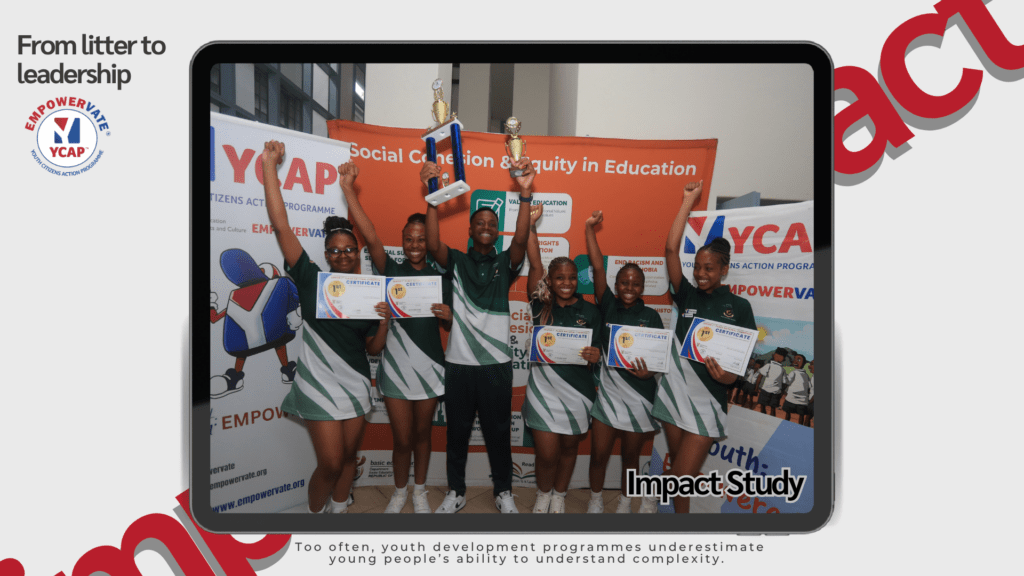
At first glance, the project developed by the Senior Champions of the 16th Annual National Youth Citizens Action Programme (YCAP) Championships (2025) may appear to be a school recycling initiative.
In reality, it represents something far more significant. Florapark Comprehensive High School from Limpopo’s Capricorn District approached a challenge many schools face daily: littering, poor waste management, and environmental neglect. However, rather than treating the issue as a simple cleanliness concern, the learners reframed it as a broader systems challenge connected to health, behaviour, school culture, climate action, dignity, and active citizenship.
That shift in thinking is important. Too often, youth development programmes underestimate young people’s ability to understand complexity. What stood out in this project was not merely the implementation of clean-up activities, but the learners’ ability to connect local school realities to national and global environmental conversations. Their presentation referenced climate change, plastic pollution, methane emissions, recycling statistics, and environmental education as part of framing the urgency of the issue.
More importantly, they moved beyond awareness into action.
The project included awareness campaigns, school assemblies, parent engagement, clean-up drives, recycling initiatives, stakeholder mobilisation, composting, tree planting, media engagement, and outreach to younger learners at a nearby primary school. This demonstrates one of the core principles of YCAP: meaningful citizenship is not taught theoretically; it is developed through participation, responsibility, and real-world problem solving.
What makes this project particularly compelling from an impact perspective is its layered value chain. The learners did not simply collect waste. They transformed waste into opportunity.
Paper, boxes, and recyclable materials were collected, sorted, and recycled through collaboration with external stakeholders. Funds generated through recycling were then used to purchase additional bins for the school and sanitary towels for learners experiencing period poverty.
This is where the project evolved from an environmental intervention into a multidimensional social impact initiative.
Environmental sustainability became linked to dignity, school participation, gender inclusion, and learner wellbeing. The project’s alignment with Sustainable Development Goals relating to health, education, gender equality, sustainable communities, and climate action was therefore not superficial; it emerged organically from the intervention itself.
Another critical insight from this project was the evidence of behavioural change.
Feedback from learners, school management, and support staff indicated that attitudes toward littering began to shift during the implementation process. Learners reportedly became more conscious of litter, cleaning staff observed increased learner participation in maintaining the environment, and school leadership reflected on how the project demonstrated learners’ capacity to lead when trusted with responsibility.
This matters because sustainable impact is rarely created through one-off activities alone. Long-term change happens when behaviours, norms, and ownership begin to shift within a community.
The project also demonstrated strong stakeholder mobilisation. Support was secured from the principal, school governing body, municipality, private sector stakeholders, media platforms, and learner leadership structures. This reflects another important lesson in youth development: young people are often far more capable of mobilising ecosystems around meaningful causes than we assume.
However, one of the most significant impacts may lie in what the learners themselves gained through the process.
Through project implementation, team members developed practical competencies in leadership, planning, financial management, administration, communication, record keeping, teamwork, and accountability. These are not abstract outcomes. They are transferable life and workplace competencies developed through experiential learning.
This is where YCAP’s value becomes particularly visible.
The programme is not simply about competitions or presentations. It is about creating environments where young people are trusted to identify challenges, engage stakeholders, manage projects, solve problems, and reflect critically on their role within society.
Importantly, projects like this also reveal something larger about the future of education and youth development. In many cases, schools already contain the potential solutions to their own challenges. What is often missing is not intelligence or willingness, but structured opportunities for learners to participate meaningfully in shaping their environments.
When young people are given practical frameworks, mentorship, and ownership, they frequently exceed expectations.
Florapark Comprehensive High School’s project serves as a reminder that youth are not merely future leaders. They are current contributors to systems change.
The challenge for the broader sector is therefore not whether young people are capable of leading meaningful change.
The challenge is whether we are creating enough opportunities, structures, and ecosystems that allow them to do so consistently, sustainably, and at scale.
#Empowervate #YCAP2025 #YouthDevelopment #ActiveCitizenship #SystemsChange #Education #ClimateAction #SustainableDevelopment #Leadership #SouthAfrica